
In Unlocking the Vault, Game Developer editor-in-chief Danielle Riendeau dives into the rich archives of the GDC Vault in order to uncover timeless game development advice, anecdotes, and hard-learned lessons tucked away within the hundreds of talks from decades of GDC shows preserved within the Vault. Every other week, this curated overview will feature key takeaways from a vintage or classic GDC Talk with the goal of helping today's developers unearth new lessons from the past.
It feels somewhat shameful to admit I've never played Dead Cells—Motion Twin's highly regarded pixel-rendered rouguelike masterpiece. But I still adore this talk from GDC 2019, aptly titled 'Dead Cells': What the F*n!?' for being a breezy, no-BS design talk that manages to pack so much wisdom into a neat little 30 minute time slot.
After introducing the studio and its previous games (and noting that the project that would become Dead Cells was a "last chance" for the studio, so they were inspired to make something bigger than they had) Motion Twin's Sebastien Benard goes right into the inspiration for Dead Cells: classic Castlevania. But the team was tiny, with only one visual artist at first (a second one came on eventually), so they just couldn't create massive, expansive content for a game in that vein. Voila: the decision to embrace permadeath at the heart of the game.
Death as progression
Notably, the team was keen to modernize the schema, which was something of a hot topic at the time.
The team smartly chose to focus on "death as progression" instead of punishment for players, allowing them to open up and explore new areas upon death, rewarding play instead of punishing failure. "Dying should be like 'woo yeah, I died, so I can do something new!'" says Bernard, gesturing with a grin and a thumbs up.
The decision to run with this structure meant there was no back-tracking between levels—so if you want to go back to an earlier area (perhaps with a new ability), you have to go ahead and die to get back to the beginning again. The team also made "each run count" a core pillar, using the titular dead cells as currency to spend with the collector, allowing for progress across runs.
Mitigating the pain of permadeath
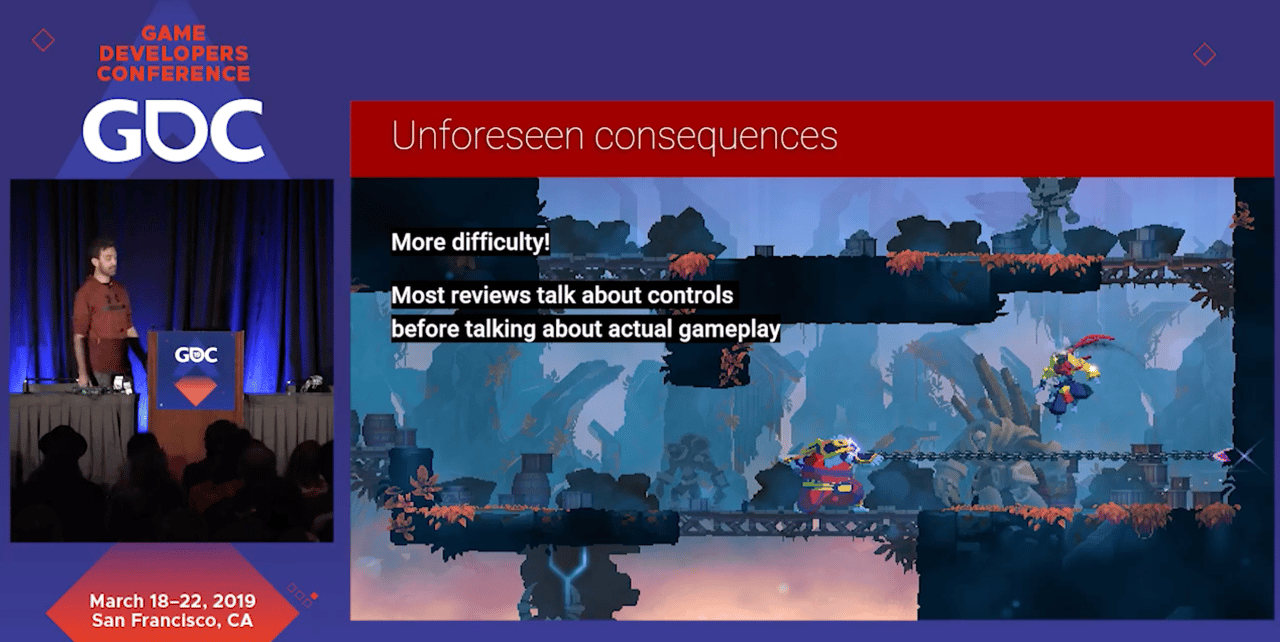
Dead Cells was designed to have a very short game over to new game loop, partially to minimize disappointment for a player death. The team also hyper-focused on a tight control scheme and modulated the challenge of the game judiciously, even offering a few small "cheats" in favor of the player to keep nasty platforming "accidents" to a minimum.
"We always asked, with the platforming for example, 'is this meant to be a challenge?'" says Bernard. "If you take Super Meat Boy, yes, the platforming is part of the challenge, it's all about jumping and getting killed and getting back to action really quickly."
"But Dead Cells is really combat oriented. Platforming is just a [means] to move, to avoid enemies, to position yourself, and it's not a hardcore platformer game. So, when we asked this question, it was really useful... 'Is the player meant to die doing this?' If the answer is no, we just make sure the player succeeds."
He then goes to show a brief clip from the game where the player jumps from one platform to another—there are a few frames where it looks dicey (maybe they won't make it!), but they succeed. Then he plays it back in slow motion. The game is absolutely correcting a poor jump here, serving to minimize frustration overall, since perfect platforming is just not a core value in Dead Cells, and this trick allows players to focus more on fighting enemies. The devs dubbed these "just in time" jumps, allowing a few frames to leap after the character's feet are actually off a platform, since the intention is there!
These little tricks are also employed in hairier combat sequences, where the game will "correct" a player's position or orientation, for example, turning towards an enemy in a close call, and auto-aiming.
Bernard noted that most players will just think they did everything correctly, and that the little cheats really helped to keep the game feeling fun. It also allowed the team to make the core game more difficult—with those little potential annoyances out of the way, they could construct much more strategic encounters that were more satisfying overall.
Unlocking the key takeaways
In case you want the sparknotes version of the talk—or you're just outlining some of the major lessons in your notes—don't worry, I've got you!
The key takeaways here are Lesson #1: Constraints can be your friend: part of the reason to embrace permadeath (and very much the core structure of the game) was having limited art resources. Dead Cells is a beloved game very much in part to its tight design around permadeath, and the team really embraced "finding the fun" in the structure. Lesson #2 here is that it's ok to cheat a little: if it makes the game more fun! Motion Twin was able to really focus on challenging, strategic combat encounters because they took care of little hiccups like jump correction and orienting the player correctly, making the game better by placing the focus squarely where they wanted it.
Game Developer and GDC are sibling organizations under Informa.