
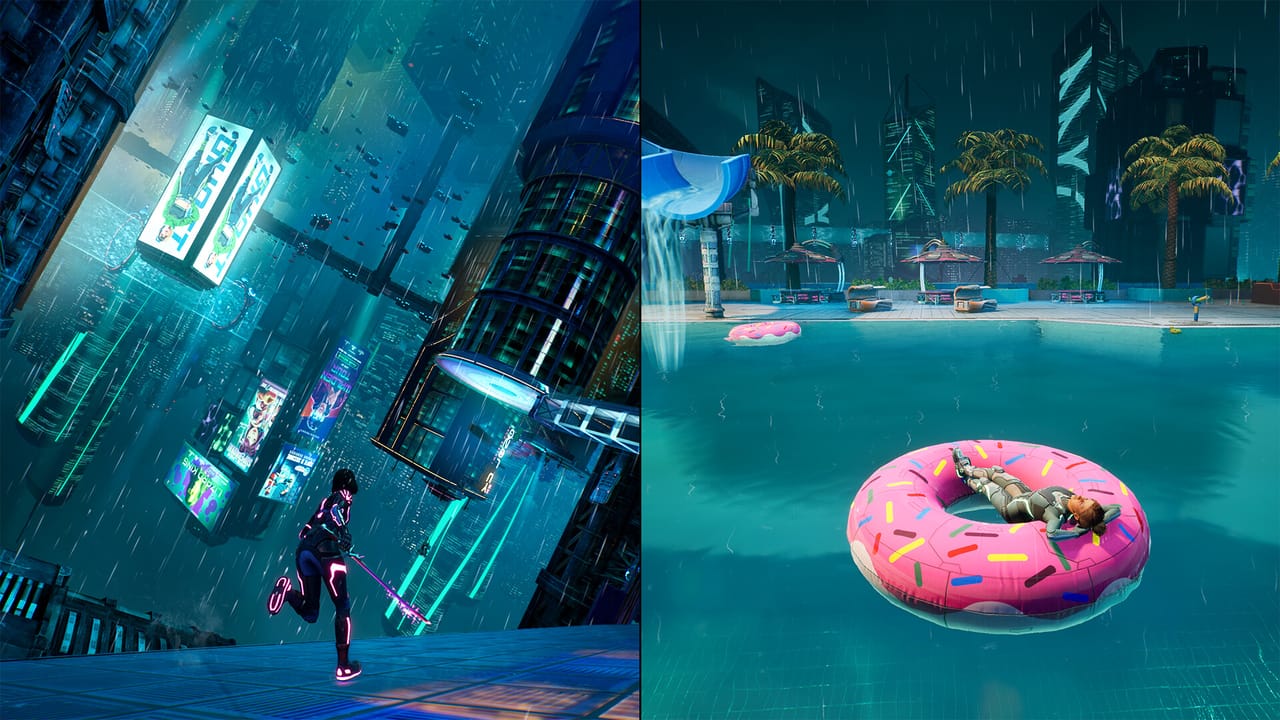
Spoilers for the final level of Split Fiction
In a talk at GDC Festival of Gaming 2026, level designer Hannes Gille welcomed the audience, then joked we had about a minute to run out of the room before he was going to spoil (and indeed, go into great detail about) the final stage of 2025's co-op hit, Split Fiction. Consider this a similar warning for this article!
Through most of the game, players control two characters in a split-screen, co-op adventure. Stages alternate between a sc-fi theme and a high fantasy wonderland. For the final level, both players find themselves in mirror universe versions of the same stage. For one character, the world appears in its sci-fi form, for the other, its fantasy twin. Players make it through the bifurcated world by working together (much as they did in previous stages), but with a major twist: some objects or properties of the world are very different for each view.
Gille showed several early prototypes and detailed the early vision of the game—a co-op experience where players would use a "portal" mechanic to throw objects from one world to another. Along the way, he paid plenty of attention to Hazelight's portfolio, including It Takes Two and A Way Out, and highlighted the importance of co-op play to the studios ethos.
Early on in the talk, Gille revealed the concept (of each stage being, essentially, both worlds, with each character seeing a different version) was originally what the team wanted for the full game. But, as they prototyped, the studio realized there would be massive challenges in doing so.
"It was especially challenging for the artists," said Gille. "They'd basically have to art two games, instead of one. It was actually a little trickier than that, since the art of the two worlds had to align with each other with a high degree of precision. It was also challenging, design-wise, especially to create a shared experience where the players never saw the same things for an entire game."
"So, in the end, it was saved for the final level."
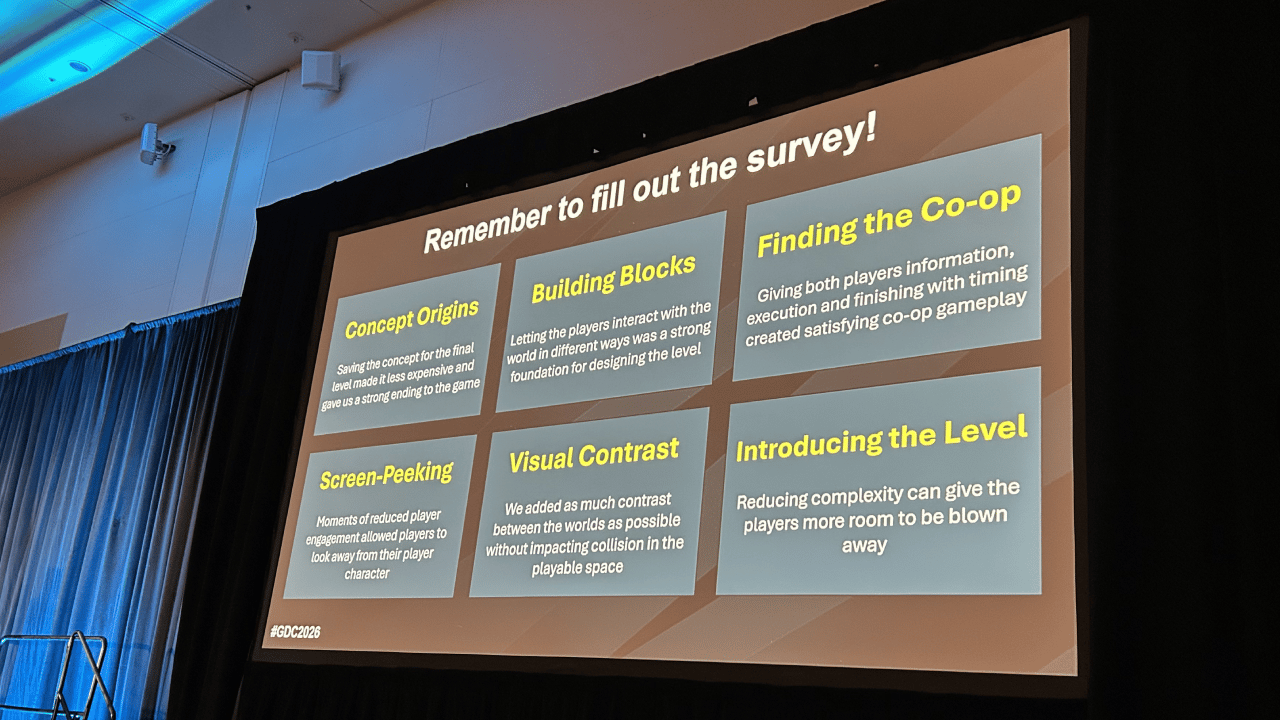
"Saving the concept for the final level made it less expensive and gave us a strong ending to the game," Gille said. "Limiting the concept to one level turned the [situation] to an expensive level, instead of an expensive game. And in the same way, limiting it to one level also really reduced the issue of the players feeling disconnected from each other."
"I also think the impact of being in two worlds at the same time (sci-fi and fantasy) was heightened by the fact that, at this point, had become accustomed to being in either sci-fi or fantasy, for over ten hours."
Gille then goes about the business of designing for this very challenging (and very well received) stage, with plenty of videos to show progress along the way. He broke down design challenges into categories, including designing engaging puzzles for both players (including many early iterations of a puzzle involving a carnivorous plant in one world/a robotic arm in the other), offering truly engaging co-op, encouraging "screen peeking" so players would want to see what's on their co-op partner's screen, and really selling the wow factor when introducing the final level.
All the hard work appears to have paid off—the game as a whole has been very well received, with the final stage getting special attention. Gille shows a few videos of lets players enjoying the level, one of whom excitedly exclaims—at one especially mind-bending moment—"whoever designed this level is a fucking genius!" to which Gille quips "his words, not mine!"
Game Developer and GDC Festival of Gaming are sibling companies under Informa Festivals.