At a Glance
- Text in games can be vital to explaining your story or game mechanics, but it's often something players avoid reading.
- Specific animation techniques can animate text and make it feel 'interactive' without being choice-driven.
- It can take a lot of work—but indie devs from Latin America have tips for how to do it on a budget.
How do you get players to read your game's text?
Developers working on narrative and non-narrative games alike have struggled with this question over and over again in game development history. It's an agonizing dilemma. You put all that work into your game's story, your flavor text, and especially your tutorial sequences—only for their eyes to glaze over as they mash the "advance" button and barely read any of it.
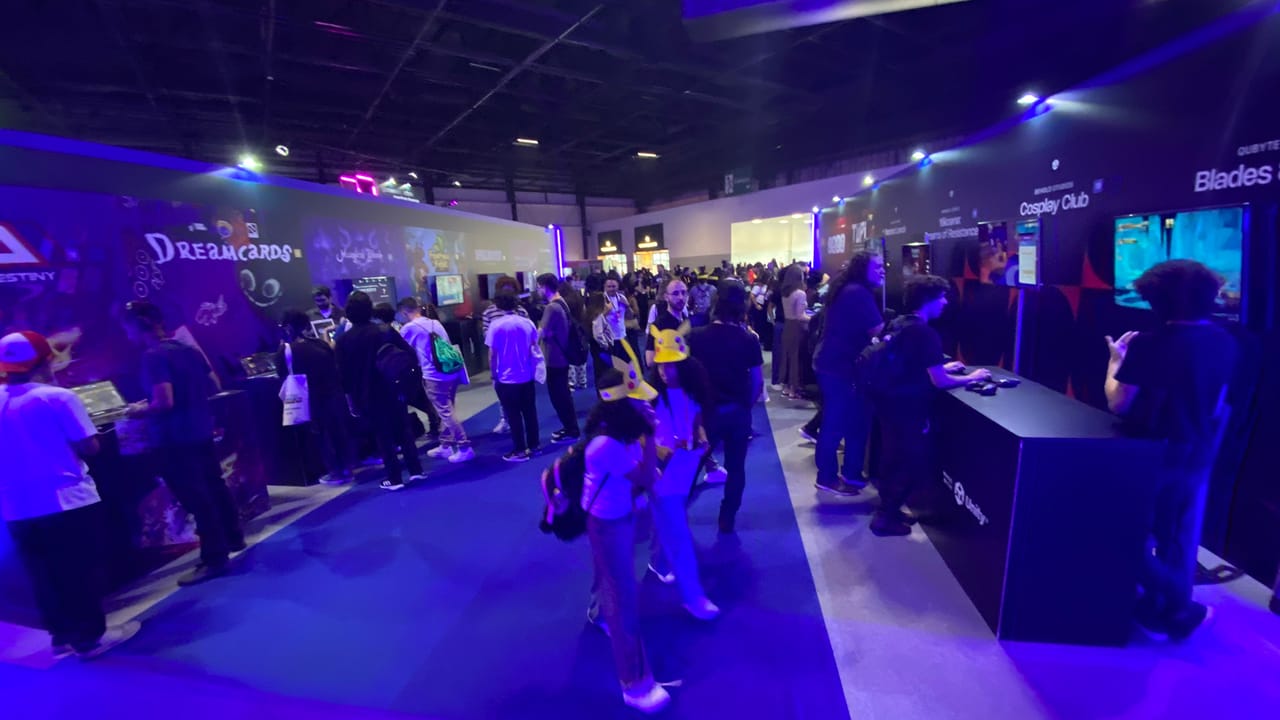
This phenomenon was on display during our recent visit to Gamescom LATAM. Across the event, an astonishingly talented cohort of independent game developers showed off games with lush visuals and finely-tuned mechanics—but one major feature made some incredibly attractive, and others less engaging: text animation.
As we've belabored before, your game's text animation plays a major role in telling your story or even just getting players to internalize your tutorials. It's also an aspect that can make your game feel "cheap" even if other elements are polished to a fine sheen.
As the developers we spoke with discussed, once you internalize that notion, a whole playground opens up to make your text feel like a part of the game world, offer commentary on events, or elegantly guide the player's eye better than a ham-fisted tutorial can.
Climb out of Hell leaves a smoldering impression
Retro-inspired side-scrolling platformers and top-down adventure games were the most popular genres across the three booths showcasing work from LATAM developers. This wasn't necessarily surprising. Developers we spoke with largely said they were using Unreal Engine, Gamemaker, and Godot, and both Unity and Gamemaker were present at the show, pitching their tech to local devs. But these developers weren't just retreading old ground. Each had their own flavorful spin with gameplay never in the SNES or Sega Genesis or Game Boy Advance games that inspired them.
Solo developer Luca Signorini's Climb Out of Hell (being released under the banner of Uendy Studios) was one such example. Signorini explained to Game Developer that he wanted to take the core gameplay system of Angry Birds—launching the player character forward by dragging the mouse or finger—and use it to fuel a lost soul's treacherous climb out of Hell.
Text in Climb out of Hell doesn't just appear onscreen, it slowly smolders, like lava oozing down a mountain or fire working its way through a piece of paper. Signorini explained that he used Unity's basic UI toolkit to make this text effect. "I have an asset called 'gamefeel,'" he said, pointing the fiery effect onscreen. "I use 'gamefeel' to make the text appear onscreen in slow motion and fade in and fade out, with a bit of a delay so players have time to take in what the text shows."
He said he was inspired by the classic definition of "juicing" in game animation, just applying it to text instead of gunfire, action, or motion. Climb out of Hell mixes traditional iconography of the underworld with some other unique inspirations, but the pleasant sensation of watching the text scroll did the most work in encouraging me to try, fail, and try again to escape the halls of the damned.
Artius: Pure Imagination embraces text as art
PVic's Artius: Pure Imagination is a feast for the eyes and an experience that speaks to every artist threatened by tech bros' promise to replace human creativity with genAI art. Gabriel Casanova, one of the games' developers, told us the game's art is inspired by the art of Brazilian cartoonist Ziraldo. Ziraldo's comics often followed energetic kids, capturing their excitement with buoyant text along with bright colors and exaggerated shapes.
Artius is made in Gamemaker, and Casanova said the team uses a specific text renderer called "Scribble." "It's an amazing library which lets you do all kinds of things with text. We made our own fonts for the game and used Scribble to create custom animations to manipulate the text. We can shrink it, change the color, and have certain individual animations for certain letters.
Casanova also raised the topic of localization when quizzed about the letter-by-letter animation choice, saying it better accommodates languages like Chinese and Japanese because of their use of special individual characters."
It's probably no surprise that a game about celebrating the arts takes such care with its visuals, right down to the text, but Casanova's tip of the hat to localization shows how the translation process can be made easier when you consider it further ahead in development. But maybe they had reason to think of it sooner—PVic and most other developers at the show supported both Portuguese and English in their games, accommodating local players and us international travelers (some of whom were publishers looking for games to sign) alike.
Ghostless places words precisely on the screen
Posted up at the Abragames booth, Coffeenauts developer Josiel R.A Silva was closely watching attendees play Ghostless, a side-scrolling science fiction post-apocalyptic game that blends the metroidvania and colony sim genres. Of the developers we spoke with, he was the one paying the most attention to how players responded to text animation. That's because according to him, Coffenauts had come to Gamescom LATAM to explicitly test Ghostless' tutorial sequence.
(Coffeenauts hasn't posted any video of Ghostless online yet, so we can't show you any videos of it in action).
Because Ghostless blends two complex game systems—one that rewards quick action and exploration and another that emphasizes resource management—teaching players how to pick it up is difficult. In previous tests, players were missing large amounts of information.
As we spoke, a player was watching text scroll across the screen one letter at a time in an unskippable text sequence, animated to resemble how text appears while typing in a retro computer terminal.
"We chose to display the text this way so the player can see the text but not immediately read all of it," he said, noting that they'd built a coroutine in Unity to mete out the text letter-by-letter in a designated timeframe. What Coffeenauts did discover, he said, was that where the text was placed onscreen mattered as much as how it was animated and the information it contained.
As we spoke, a player progressing through the tutorial interacted with a non-playable character whose dialogue was animated in the middle of the screen, floating above her head. But the tutorial information Silva was focusing on appeared in a text box on the bottom of the screen. This is because, according to Silva, how text appears relative to gameplay can change how players feel about the game.
"When you have a tutorial in the middle of the screen, players feel you're blocking their gameplay," he said. "Text on the bottom of the screen doesn't block the player's control."
By contrast, text in the middle of the screen—be it dialogue, journal entries, or other elements that emerge from gameplay—is text they were "waiting" to see. Or put in other words, it's text that appears as an outcome of the player's behavior, and therefore more easily fits in the flow of gameplay instead of interrupting it.
[AFANTASIA] makes meaning with fonts and position
Finally, we have Afantasia, the game that probably made the most complex use of text animation across all of Gamescom LATAM. This surreal psychological adventure comes from solo developer Leon Stevens, operating under the studio name "noidnoidnoid."
The game follows a young boy who "bargained his memories for the ability to imagine," and now wanders through his hometown, rendered in a variety of pixelated visuals. He weaves through the town, re-living the memories of the people (and sometimes animals) who lived there. Each sequence makes use of a different style of gameplay and art direction, and in the regular gameplay sequences, the player character has interior conversations with his own psyche, guided by Jungian-inspired choices in a dialogue tree.
Most importantly for our purposes—its text animation is constantly changing throughout each of those sequences.
For instance, when the player character is speaking with his inner self in the general 2D adventure sequences, text appears above the character's head and towards the upper portion of the screen, each side of the conversation shown in different colors. But in one memory sequence where the player is embodying a dog's memory in a first-person view, text appears both in the environment itself and in a black letterbox bar on the side of the screen.
Text appears in different positions on the screen, uses different fonts, colors, and position to sell [AFANTASIA]'s surreal story. "Each [text] character is a component in the user interface," Stevens explained. The text is produced through Motion Design in Unreal Engine.
"My system is based on data tables. Each letter spawns a component that has independent animations and they start to offset randomly. Each letter is animated by a curve that translates the position at a random time in that curve. I instantiate each character as a component, and each component is animated."
The biggest challenge to working this way, he said, is to make sure players know when text has ended and they can progress forward. That meant making sentence-ending punctuation like ellipses, exclamation points, and question marks as visible as possible.
Stevens' work on [AFANTASIA] captured the power of what we saw across these and a number of other games: text isn't just an obligation, it's a dynamic system that can be as interactive or as inert as you want it, and it's a vast open playground for developers to explore artistic intent or A/B test features that drive player retention.
Onscreen, his protagonist was waxing poetic about the nature of existence and emotions. But his explanation for making these different choices boiled down to one sentence: "I really, really like to play with different UI positions."
Game Developer was invited to Gamescom Latam by event partner Abragames, which covered flights and accommodation.